

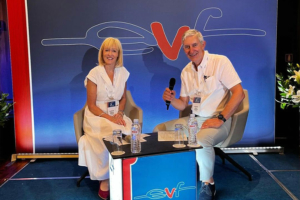
At the recent conference of the European Venous Forum in Athens, Pam Silas who is our experienced nurse presented this new therapy. She has developed a new technique using microfoam for thread veins.  This enables a much wider area to be successfully treated which reduces the number of sessions required compared to traditional microsclerotherapy. This reduces the cost of treating extensive thread veins and has good patient satisfaction.

ClariVein has overcome the risks of previous varicose vein treatments such as laser (EVLT) , radiofrequency ablation (RFA) and ultrasound ablation. These treatments although equally effective, work by burning the vein and therefore require the injection of large amounts of local anaesthetic. These multiple injections are painful and give a tight sensation in the leg. ClariVein has been shown to be 2.8 times less painful than Laser.

The risk of heating up the vein is that there are nerves directly beside the veins and if they get burnt there is nerve damage which can cause significant problems especially below the knee. ClariVein doesn’t work using heat so cannot cause nerve damage.

Failure at first follow up appointmentNerve DamageReturn to Work in daysRecurrent Varicose VeinsYears follow up
ClariVein4%ZeroSame day113
Laser (EVLT)6.8%5-10%3.638.65
Radiofrequency (RFA)5.8%5-26%2.918.75
Foam31.5%Zero2.931.75
Open Surgery6.3%5-10%4.323.45

Foam sclerotherapy has good results for small veins but has a high recurrence rate for major veins.

Cyanoacrylate glue causes a phlebitis reaction in 20% of people which causes pain for 1-2 weeks and also allergic reactions like contact eczema are common. It is equally painful to radiofrequency ablation. It is more expensive.

ClariVein is therefore virtually pain free, cannot cause nerve damage, does not cause allergic reactions and yet has the same excellent results as other treatments. Because it is less painful, patients can walk in, have a 45 minute treatment and then walk out and drive back to work with no time off.

References:- Venous News September 2017, November 2017, March 2019


Dr Tobias Hirsch, Halle, Germany


Dr Hirsch made a presentation to the Liepzig Interventional Course on the side effects of glue in the treatment of varicose veins, which has been published in Venous News March 2019

In 2011 the American Venous Forum recommended thermal ablation (Heat with either laser or radiofrequency) as standard treatment of varicose veins. However these methods require large volumes of local anaesthetic which is painful , can cause discolouration of the skin (hyperpigmentation) and nerve damage in up to 10%. Therefore newer methods have been looked for.

Cyanoacrylate glue has been shown not to be inferior to other treatments like Laser, RF or ClariVein in its ability to ablate the primary vein. It is simple to do but the manufacturers advise not to inject glue within 5cms of the junction with a deep vein as this could lead to a Deep Vein Thrombosis (DVT). However most recurrences come from the top  5cms which is untreated with glue therapy. This is obviously of concern.

With cyanoacrylate glue “we have to consider toxicity and allergenic risk especially as it takes along time for adhesive to be reabsorbed. All trials show an excellent occlusion rate, but all trials also show a phlebitis-like reaction in up to 20% of cases” Therefore patients may have pain for 1 to 2 weeks and experience generalised skin affections. Talking about side effects Hirsch said that “acrylates are known to cause allergic reactions such as contact eczema. The only way to treat contact eczema is to halt exposure” Obviously the glue injected into varicose veins cannot be removed. Other symptoms such as hives and itching can be treated with antihistamines.

In choosing what method is used to treat  varicose veins, the key issues are:-

a) Does it ablate the vein treated ? – in this respect most treatments are equivalent

b) What side effects are there ? – Pain and nerve damage for Laser and Radio-frequency, Painful phlebitis and skin rashes for cyanoacrylate glue, None for ClariVein

c) What is the recurrence rate? Being unable to treat the top 5cms safely with Glue is concerning. Recurrence for ClariVein/Laser/RF are equivalent